

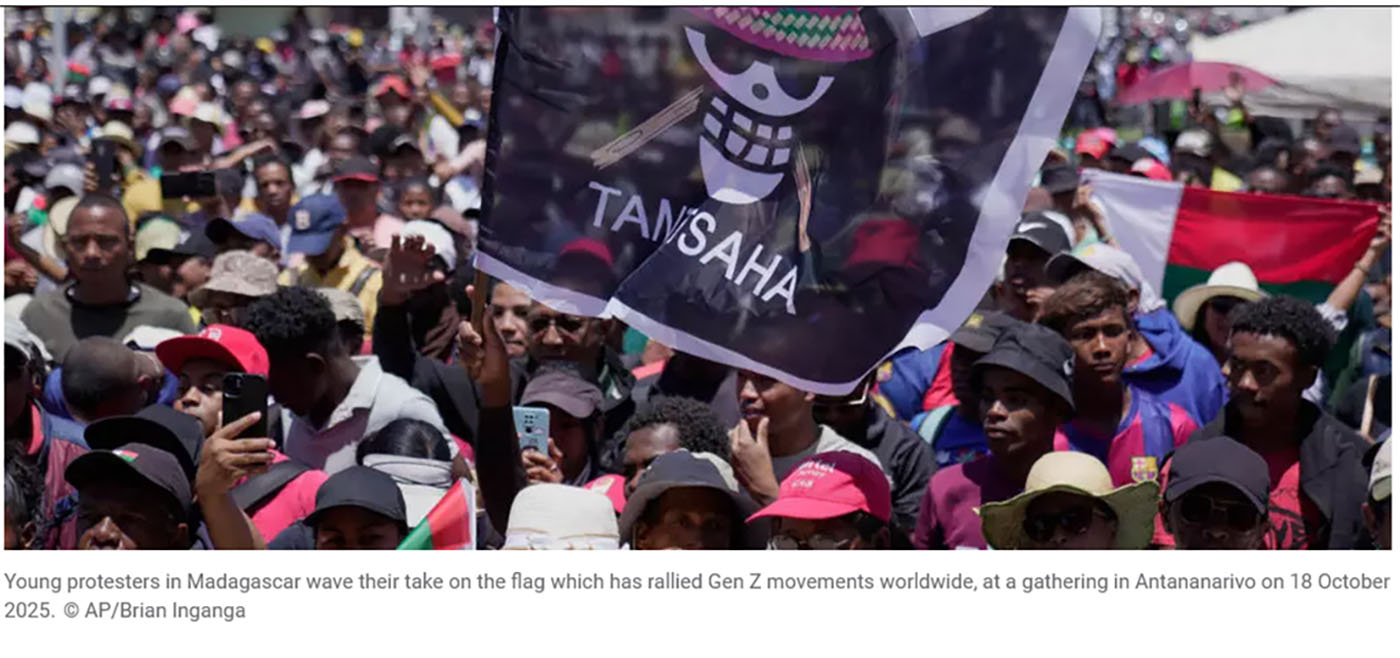
Photo Credit: AP/Brian Inganga
More than a month after young people in Madagascar began protesting, winning the support of the military, a new government was sworn in. It was one of the most striking demonstrations of how Gen Z movements around the world are organising to demand basic public services and fundamental rights. Three young Malagasy tell RFI what drove them onto the streets, and what they hope for next.
“My own personal experience of Gen Z Madagascar was very distressing and freeing at the same time,” said 26-year-old Rocks, one of the driving forces behind the movement.
“I felt like I was sending people to their deaths as we were being gassed, shot at, brutalised and arrested by the police. I cried so much until the military joined us,” he told RFI.
Young people began demonstrations in the capital Antananarivo and five major cities on 25 September. Angered by incessant power outages and chronic water shortages, they demanded that then president Andry Rajoelina step down.
The gendarmes intervened, at least 24 people were killed within a few days, according to the United Nations, including a baby who died after inhaling tear gas.
“I knew that things were going to change because we, the Malagasy people, seldom demonstrate and we never protest even when we feel that things have gone too far,” said Sariaka Senecal, one of Gen Z Madagascar’s spokespeople and a diplomatic relations officer.
She joined the movement from the outset, chatting on the group’s Instagram page with a handful of local and diaspora followers in the United States, France, Germany, Canada and Mauritius.
Her family doubted that her posts on social media could bring about change.
“Throughout the uprising, I was torn between hope and despair. I was scared of being thrown into jail, I was afraid for my life, for my family because I decided to speak out,” she told RFI.
“There was this all-powerful mafia of the former regime who could just do anything.
"The first time I finally agreed to speak on camera for an interview, it was for Brut, an online French media; that meant we could reach a wider audience. Afterwards, I locked myself at home because I was much too afraid to go out."
Rocks’ journey started three years earlier, when a whistleblower friend of his started to write about what he called the corrupt activities of the Rajoelina regime on his Facebook page. When his friend was arrested in October 2022, Rocks promised to continue his fight.
The whistleblower was released on 15 October of this year after former president Rajoelina was ousted and the military took over.
Rocks said he knew it was the right time to strike when he saw Gen Z movements rising across the globe – in Sri Lanka, Bangladesh, Indonesia, the Philippines, Timor-Leste, Peru, Morocco, Kenya and Nepal.
“There was this wind of change blowing, I realised this was our time to light up the fire and stand up for our rights. It pushed me to call on the young people to rise against corruption, dictatorship, human rights being trampled,” he added.