

Photo Credit: Getty Images
Kenya’s public university lecturers have rejected a government pay offer worth about KSh 3.1 billion ($20 million), prolonging a nationwide strike that has now entered its sixth week and left tens of thousands of students in academic limbo.
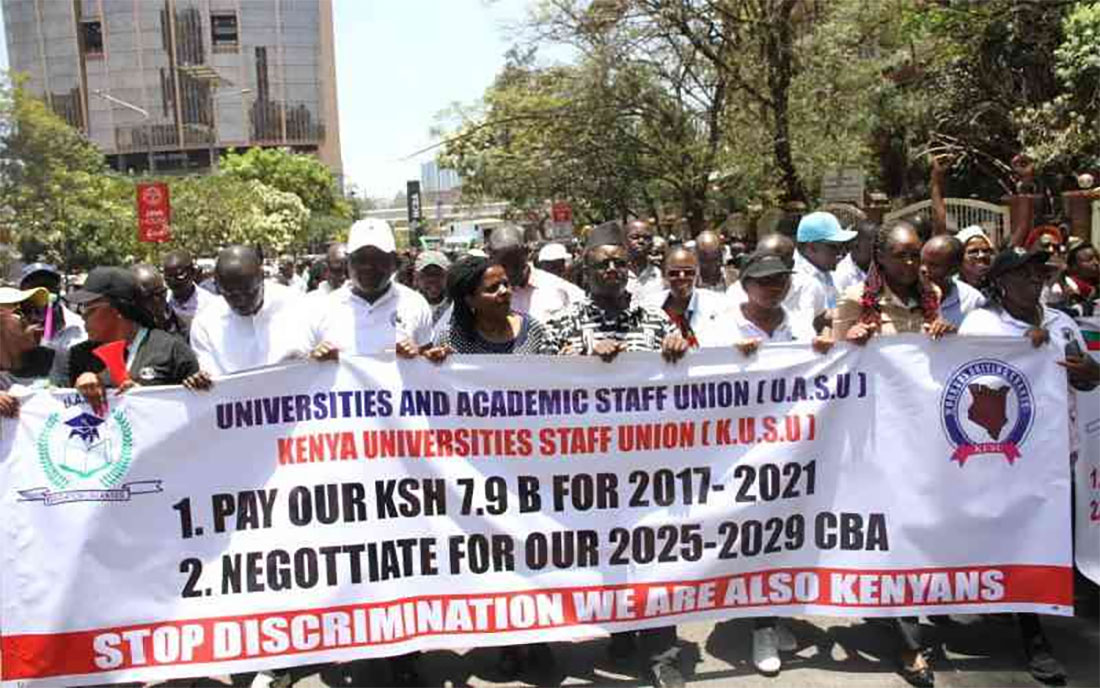
The industrial action, led by the Universities Academic Staff Union (UASU), has crippled operations in public universities across the East African nation. Lecturers accuse the government of failing to honour past salary agreements and ignoring the rising cost of living, which they say has eroded their purchasing power.
According to UASU, the government’s latest offer — tabled by the Salaries and Remuneration Commission (SRC) — is “unacceptable and unrealistic.” The union insists that before discussing any new pay deal for 2025–2029, the government must first settle an outstanding KSh 7.9 billion ($50 million) debt from the 2017–2021 collective bargaining agreement (CBA). “We will not resume work until the government fulfils its obligations,” said UASU Secretary-General Constantine Wasonga, who has accused authorities of “playing games” with workers’ livelihoods.
The SRC maintains that its KSh 3.1 billion proposal is the most the Treasury can afford, citing budgetary constraints and a push to keep public sector spending sustainable. Education Cabinet Secretary Ezekiel Machogu has urged both sides to return to negotiations, warning that prolonged disruption could derail Kenya’s higher-education system, which attracts thousands of students from across the continent.
The stalemate has sparked growing concern among parents and students, many of whom fear their academic years will be extended or their graduation delayed. Several universities have already suspended classes indefinitely, while administrators warn that reopening without lecturers would compromise learning standards.
University unions in neighbouring countries have expressed solidarity with their Kenyan counterparts, framing the standoff as part of a wider struggle across Africa over fair pay and respect for academic labour. In Nigeria, South Africa, and Ghana, similar strikes in recent years have highlighted the tension between austerity-driven governments and overworked educators.
Kenya’s universities have long been pillars of regional scholarship and innovation, producing graduates who serve across Africa and beyond. But the ongoing standoff underscores the financial and institutional strain facing public higher education in developing economies.
As the strike enters its sixth week, no clear resolution is in sight. UASU says it will not call off the industrial action until the government makes a “serious, written commitment” to clear all arrears and negotiate a credible pay rise. Meanwhile, students — some already preparing for final exams — remain uncertain about when classes will resume.
Unless talks resume soon, observers warn, the impasse could not only disrupt Kenya’s academic calendar but also shake confidence in one of Africa’s most vibrant higher-education systems.