

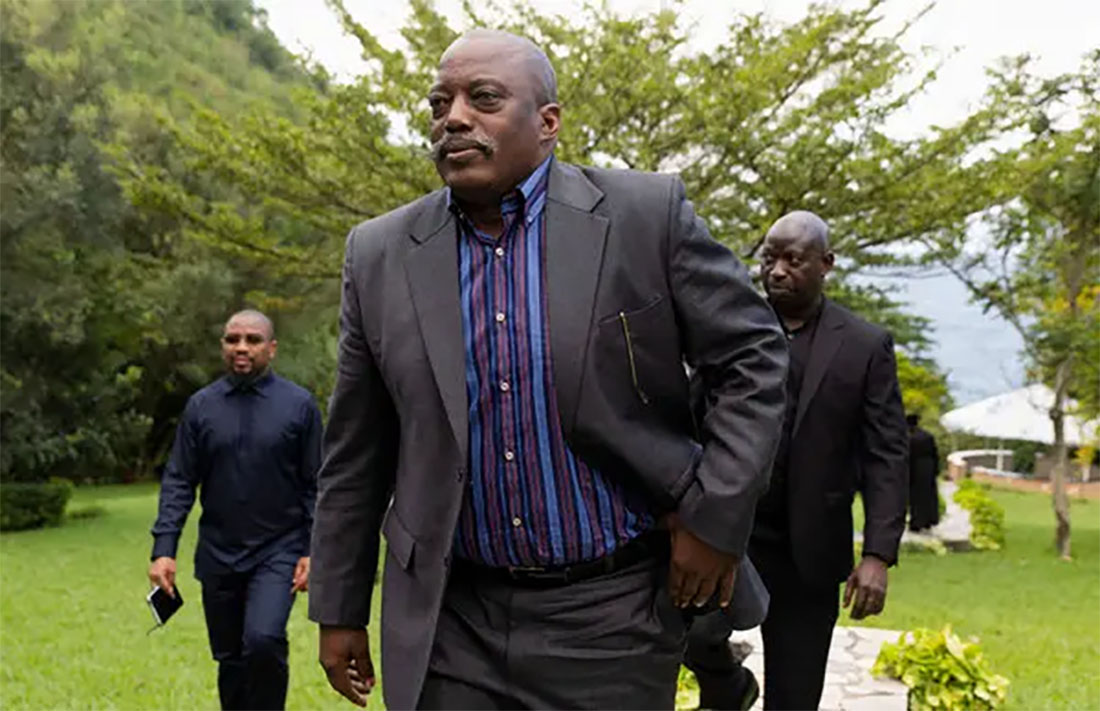
Photo Credit: Getty Images
Former Democratic Republic of Congo (DRC) president Joseph Kabila has been sentenced to death in absentia by a military court, found guilty of treason, crimes against humanity, and war crimes. The verdict, delivered on Friday, marks one of the most dramatic moments in the country’s turbulent political history.
The charges center on accusations that Kabila supported the M23 rebel movement, a group that has caused widespread destruction across eastern Congo. The court held him responsible for crimes including murder, sexual assault, torture, and insurrection. Alongside the death penalty, the judges ordered Kabila to pay a fine of $33 billion (£25 billion).
Kabila, who ruled the DRC for 18 years after succeeding his father Laurent-Désiré Kabila in 2001, did not attend the trial. He dismissed the entire process as “arbitrary,” alleging that the judiciary had been turned into an “instrument of oppression.” His current whereabouts remain unknown following his return from a period of self-imposed exile earlier this year.
The ruling has provoked fierce reactions at home and abroad. Kikaya Bin Karubi, a close ally of Kabila and a former minister, described the proceedings as “theatrical” and accused President Félix Tshisekedi of orchestrating the trial to eliminate political rivals. “The court has not seen any evidence linking Kabila to the M23 rebel group,” Karubi told the BBC.
M23’s leader, Bertrand Bisimwa, also condemned the decision. Writing on X, he argued that the sentence violated ongoing peace negotiations between the group and the Congolese government, raising concerns that the verdict could derail fragile talks.
The case has further deepened the rift between Kabila and Tshisekedi, who once enjoyed an alliance. Kabila backed Tshisekedi in the disputed 2019 elections, but relations soured in the following years. In 2023, Kabila went into exile after losing political immunity, which senators revoked under Tshisekedi’s leadership.
The conviction comes against the backdrop of renewed violence in eastern Congo, where the M23 has captured significant territory, including the key cities of Goma and Bukavu as well as two airports. The group’s resurgence has displaced hundreds of thousands of civilians and intensified instability in one of Africa’s most resource-rich regions.
International attention has increasingly focused on Rwanda’s alleged role in the conflict. The United Nations and several Western governments accuse Kigali of backing M23 and deploying thousands of soldiers inside the DRC. Rwanda denies these allegations, insisting its actions are defensive and aimed at preventing the violence from spilling across its borders.
Despite a ceasefire agreement reached in July, clashes have persisted, undermining hopes for peace. Kabila, who returned to Goma earlier this year claiming he wanted to contribute to resolving the crisis, is now at the center of one of the most contentious trials in Congolese history.
As the political and military situation remains volatile, the sentencing of the former president risks inflaming tensions further, with critics warning it could destabilize both the peace process and the country’s fragile democracy.