Photo Credit: Getty Images
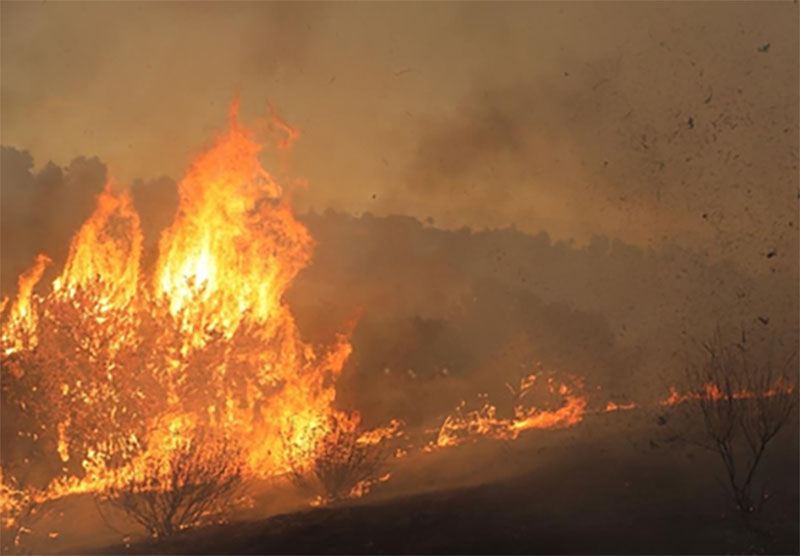
Namibia has called in the army to battle massive wildfires sweeping across Etosha National Park, one of Africa’s largest and most important game reserves. The blazes, which began on September 22 in the park’s southwest, have already scorched more than a third of its territory, threatening wildlife, biodiversity, and nearby communities.
According to the Ministry of Environment, Forestry and Tourism, about 775,163 hectares (1.9 million acres) inside the park have burned so far — roughly 34% of its total area. Another 171,098 hectares (423,000 acres) of land outside the park has also been destroyed. In a statement, the ministry described the ecological damage as “extensive,” and said the fires were believed to have been sparked by suspected charcoal production on commercial farms bordering the park.
The scale of destruction has prompted the Namibian government to deploy significant resources. On Sunday, the office of acting President Lucia Witbooi announced that 540 soldiers had been dispatched, supported by helicopters, to help contain the flames. “The fire poses a significant threat to the biodiversity, wildlife and livelihood of the communities in the affected areas,” the statement warned. While no human casualties have been reported, the number of animals killed remains unknown.
Images and videos obtained by Reuters showed thick black smoke rising near the park, underscoring the severity of the disaster. Satellite images captured by Maxar Technologies further revealed the vast extent of the scorched land. Officials said that strong winds and extremely dry vegetation have fueled the fire’s rapid spread, making containment a formidable challenge.
By Monday morning, Prime Minister Elijah Ngurare Manongo confirmed in a post on X (formerly Twitter) that the fires inside and outside Etosha had been contained, though hotspots remained. “When there is teamwork there is no challenge we cannot overcome,” he wrote, praising the joint effort of firefighters, soldiers, and local communities.
Etosha National Park is Namibia’s flagship tourist destination, attracting around 200,000 visitors each year. It is home to 114 mammal species — including elephants, lions, giraffes, and the critically endangered black rhino — as well as 340 bird species. The park also features a vast salt pan spanning 4,730 square kilometers (1,826 square miles), so large it can be seen from space.
Historically, fires were a natural part of Etosha’s ecosystem, ignited by lightning strikes about once a decade. However, aggressive firefighting policies in past decades disrupted this natural cycle. In recent years, park officials have reintroduced controlled burning to help manage vegetation and reduce the risk of catastrophic wildfires. The current blaze is being compared to the devastating 2011 fires that killed dozens of animals and burned nearly 370,000 hectares (940,000 acres).
Authorities continue to monitor the situation, with efforts focused on protecting both wildlife and the communities living around Namibia’s treasured national park.